


A
12 Posts in this encyclopedia categoryAir absorption
Sound waves propagating through the air over large distances are partially absorbed by the air, depending on temperature and humidity conditions. Part of the sound waves’ energy is transformed into frictional or thermal energy.
Air-borne sound
Air-borne sound is defined as the propagation of sound waves through the air. Air-borne sound propagates only in the form of longitudinal waves.
Air-borne sound attenuation
Air-borne sound attenuation is the weakening of an air-borne sound event by means of sound-absorbing materials. Most effective for this purpose are absorber materials that present a large surface area with open pores through which the sound waves can enter. The resulting oscillation of the air molecules inside the pores converts the sound energy into heat due to friction losses at the pore walls.
Air-borne sound insulation
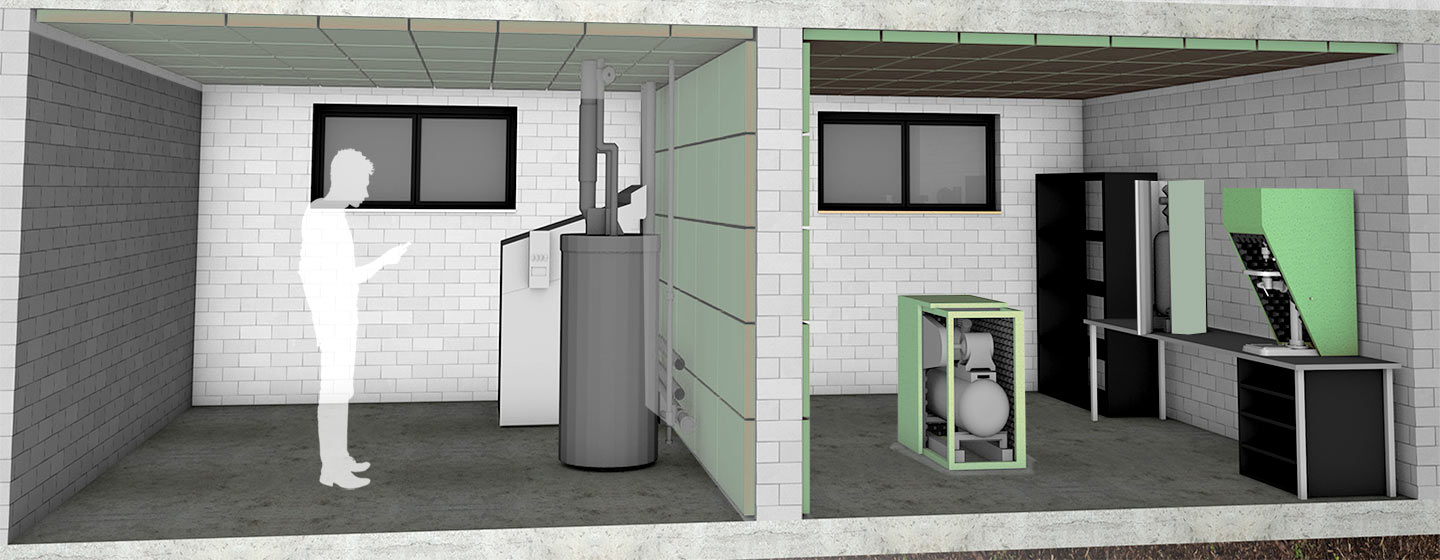
Air-borne sound insulation impedes the transmission of air-borne sound to adjacent areas. This can be achieved for ex. through the encapsulation of the sound source or the construction of noise insulation walls. Effective insulation requires heavy and preferably flexible acoustic materials.
Anechoic chamber/acoustically dead room
An anechoic chamber is an acoustic laboratory the inner surfaces of which are covered with sound absorption materials in order to (almost) completely eliminate the reflection of sound waves.