
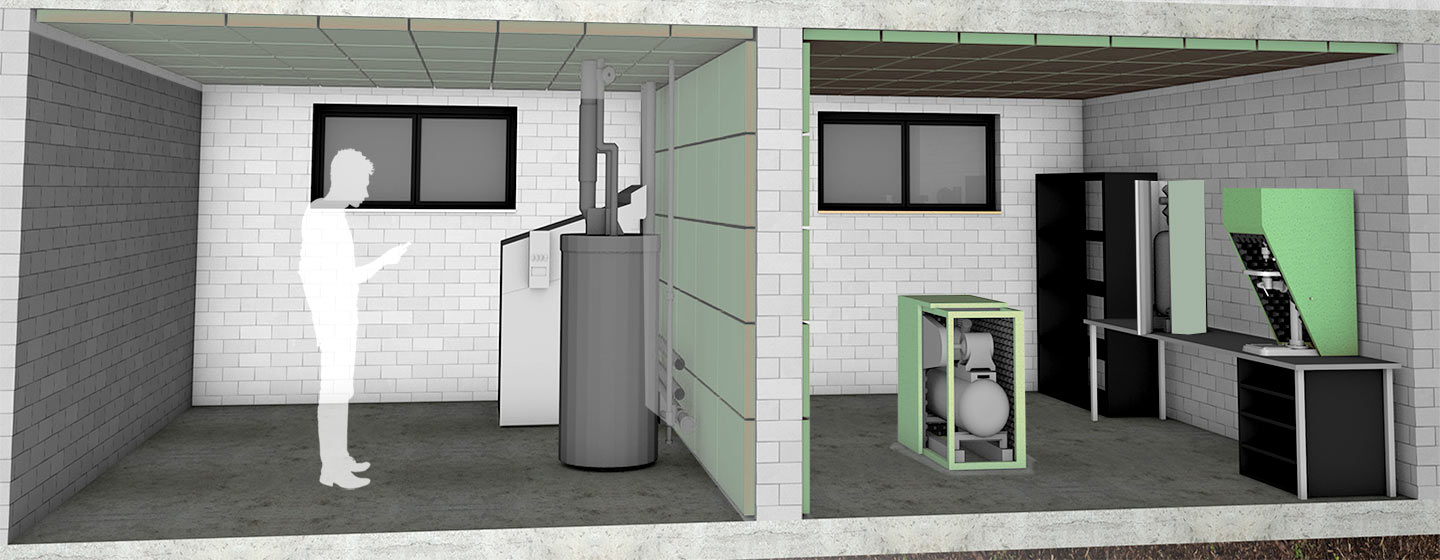

Reverberation chamber
Reverberation Chamber – Why it is important for the development of effective sound absorbers
What is a reverberation chamber?
A reverberation chamber is a specialised test room for acoustic measurements. Its surfaces are almost entirely sound-reflective, so that sound waves are distributed evenly throughout the room and reverberate for a long time.
These unique properties enable acoustics experts to determine precisely how well a material absorbs sound and what effect it has on room acoustics. For this reason, reverberation chambers are used worldwide in the research, development and quality testing of sound absorbers.
At Cellofoam, we have our own reverberation chamber and carry out the measurements ourselves. This enables us to directly test and further develop the acoustic properties of our products, and to document the measurement results in a transparent manner.
How does a reverberation chamber work?
A reverberation chamber has very few sound-absorbing surfaces, unlike living rooms, offices, or classrooms. In a reverberation chamber, sound is reflected almost entirely off the walls, ceiling, and floor, creating what is known as a diffuse sound field, in which sound strikes a test object from all directions.
During a measurement, the reverberation time of the empty room is first determined. The material to be tested is then introduced, and the measurement is taken again. The change in reverberation time allows us to calculate how much sound energy the material absorbs.
Thanks to our in-house reverberation chamber, we can perform these measurements on-site and evaluate the effectiveness of acoustic solutions under controlled conditions.
What parameters are measured in a reverberation chamber?
Reverberation chambers are primarily used to determine key acoustic parameters:
• Sound absorption coefficient (α) - How much sound energy is absorbed by a material?
• Reverberation time (T60) - The time it takes for the sound level to decay by 60 dB
• Equivalent absorption area
• Acoustic effectiveness of wall and ceiling absorbers
These values help to objectively compare the performance of acoustic products and select them specifically for different rooms.
Why Are Reverberation Chamber Measurements Important?
Anyone who wants to improve the acoustics in a room needs reliable data. Only through measurements that comply with standards can one determine how effectively a sound absorber actually works.
The values determined in the reverberation chamber form the basis for:
• planning room acoustics measures
• selecting suitable acoustic products
• calculating reverberation times
• optimizing offices, living spaces, schools, or meeting rooms
This provides planners, businesses, and individuals with a transparent basis for their decisions.
Which products are tested in the reverberation chamber?
Typical test items at our facility include:
• Acoustic panels
• Wall absorbers
• Acoustic art
• Partition walls
The measurement results show how effectively the products can reduce reverberation and improve speech intelligibility.
Reverberation Chamber and Room Acoustics – The Connection
Measurements in the reverberation chamber are conducted under idealized laboratory conditions. The results provide a reliable assessment of how our soundproofing products will perform later in real-world rooms.
Especially in modern living spaces with large glass surfaces, open floor plans, or hard flooring, our soniflex sound absorbers can help significantly reduce disruptive reverberation and create more pleasant acoustics.
The data collected in our in-house reverberation chamber helps us provide customers with informed advice and recommend suitable solutions for a variety of room configurations.
Conclusion
A reverberation chamber is one of the most important tools in acoustics. It enables the precise measurement of sound absorption and provides objective data for evaluating acoustic products. For consumers, this means greater transparency and the assurance that tested sound absorbers can actually help improve room acoustics.
With our own reverberation chamber and the ability to conduct measurements ourselves, we at soniflex lay the foundation for high-quality, verifiably tested acoustic solutions.
Frequently Asked Questions (FAQ) About Reverberation Chambers
What is the difference between a reverberation chamber and a normal room?
A reverberation chamber has highly sound-reflective surfaces and a long reverberation time. Normal rooms contain furniture, textiles, and other elements that absorb sound and reduce reverberation.
Why are sound absorbers tested in a reverberation chamber?
Only under standardized conditions can the acoustic properties of different products be objectively compared and evaluated. The measurement results serve as an important basis for selecting suitable acoustic solutions.
Does soniflex have its own reverberation chamber?
soniflex is a brand of Cellofoam GmbH. Cellofoam operates its own reverberation chamber for acoustic measurements and product testing. As a result, soniflex customers benefit from precisely tested acoustic solutions and verifiable measurement data.
Are reverberation chamber measurements relevant for private living spaces?
Yes. The parameters determined in the reverberation chamber help in selecting suitable acoustic solutions for living spaces, home offices, kindergartens, schools, and much more.
Can reverberation be reduced in living spaces?
Yes. Acoustic wall hangings, wall absorbers, or acoustic panels can often significantly reduce reverberation and improve speech intelligibility.
Content: 0.5 m² (€71.80* / 1 m²)
Content: 0.384 m² (€67.19* / 1 m²)

Content: 0.5 m² (€0.00* / 1 m²)
Content: 0.5 m² (€99.80* / 1 m²)