





Noise Insulation
Noise insulation comprises measures designed to reduce the transmission of noise from a sound source to another area. The aim is to specifically shield against disruptive noise and thereby reduce noise exposure for people, machines, vehicles, or the surrounding environment.
Noise insulation plays an important role particularly in mechanical and plant engineering, automotive technology, construction, building services engineering, as well as in technical devices and systems. Depending on the sound source and transmission path, different insulation materials and structural measures are used.How does noise insulation work?
Noise can propagate in different ways. Basically, a distinction is made between airborne sound and structure-borne sound.
Airborne sound propagates through the air. Typical examples include engine noise, machine noise, conversations, or fan noise. To reduce the transmission of airborne sound, sound-insulating materials and multilayer constructions are used, for example. Heavy and dense materials can make it more difficult for sound to pass through walls, housings, or panels. Structure-borne sound, on the other hand, is transmitted through solid components. Vibrations from engines, pumps, compressors, or other machines can, for example, be transferred into housings, frames, or adjacent structures. Suitable decoupling and insulation measures can reduce this transmission. Effective noise insulation therefore aims to address the source of the sound and the transmission path as specifically as possible.Noise insulation, sound insulation, and sound absorption
The terms noise insulation, sound insulation, and sound absorption are often used interchangeably in everyday language. From a technical perspective, however, they describe different approaches.
Sound insulation refers to measures that reduce the transmission of sound from one area to another. It is used, for example, in machine housings, partition walls, vehicles, or soundproof enclosures. Sound absorption, on the other hand, reduces sound reflections within a room, housing, or enclosure. Sound-absorbing materials such as acoustic foams or acoustic felts absorb part of the sound energy. This reduces reverberation and reflections. Sound damping is often used as a general term for measures aimed at reducing noise. In technical acoustics, it can refer, for example, to the targeted reduction of vibrations or noise levels within a system. For effective noise control, these measures are often combined.Which materials are used for noise insulation?
Various materials are available for noise insulation. The appropriate solution depends, among other things, on the sound source, frequency range, available installation space, and environmental conditions.
Examples include: • Heavy foils and heavy insulation materials: They increase the mass per unit area of a construction and make the transmission of airborne sound more difficult.• Acoustic foams: They absorb sound and reduce reflections and reverberation inside housings, enclosures, or rooms.
• Acoustic felts: They can be used for sound absorption and as part of multilayer insulation systems.
• Composite materials: By combining different material properties, both sound insulation and sound absorption can be achieved simultaneously.
• Decoupling and damping elements: They reduce the transmission of structure-borne sound and vibrations between components.
Where is noise insulation used?
The requirements for noise insulation vary considerably depending on the application.
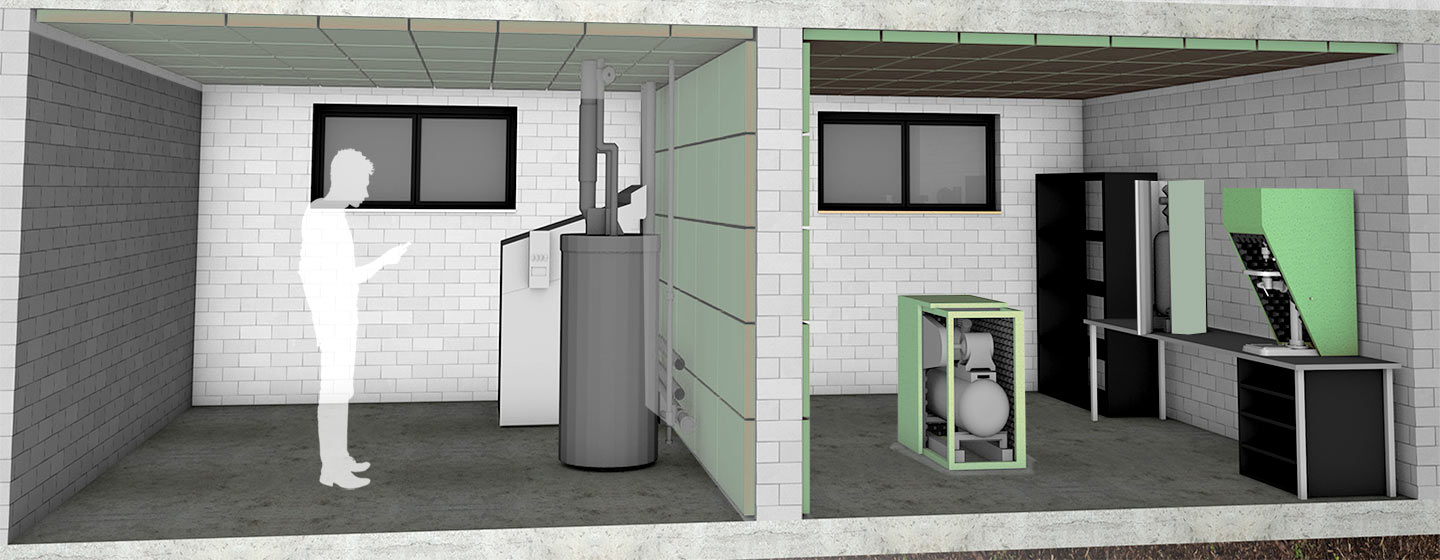
Machines and industrial equipment Machines, engines, pumps, compressors, and other technical systems can generate significant levels of noise and vibration. Insulation materials are used, for example, in machine housings, covers, enclosures, and technical rooms to reduce sound transmission. A combination of sound insulation, sound absorption, and structure-borne sound decoupling may be required. Vehicles and rail vehicles Vehicles also generate noise from engines, transmissions, exhaust systems, fans, pumps, and driving movements. Noise-insulating materials can be used in engine compartments, passenger areas, and technical areas to reduce interior noise levels and sound radiation to the outside. This applies, for example, to passenger cars, commercial and construction vehicles, buses, and rail vehicles. Heat pumps and building services engineering Heat pumps, ventilation systems, air-conditioning units, and other technical systems generate operating noise that can be perceived both inside a building and in the surrounding environment. Suitable insulation and absorption measures can help reduce these noises. Cabins, enclosures, and covers A commonly used measure for noise reduction is the enclosure of a sound source. In this approach, a machine or technical unit is surrounded by a construction that has been acoustically optimized. The interior surfaces of such enclosures can be lined with sound-absorbing materials. At the same time, insulating layers ensure that as little sound as possible is transmitted to the outside.Why is noise insulation important?
Noise can impair communication and concentration and, in the case of prolonged exposure to high noise levels, can place considerable strain on people. Noise insulation is therefore particularly important in industrial working environments.
Targeted reduction of machine and operating noise can help make workplaces more pleasant, reduce acoustic exposure, and comply with noise protection requirements. Noise insulation also plays an important role outside working environments. In vehicles, buildings, or technical systems, it helps limit disruptive operating noise and improve acoustic comfort.Planning noise insulation effectively
Effective noise insulation begins with an analysis of the sound source and the transmission path. Factors to be considered include sound pressure level, frequency spectrum, airborne or structure-borne sound, available installation space, as well as temperature, fire protection, and resistance requirements.
Not every insulation material is suitable for every sound source. While heavy materials are used primarily to reduce sound transmission, open-cell foams and felts are mainly suitable for sound absorption. For vibrating machines, additional measures for structure-borne sound decoupling may be required.Noise insulation at a glance
The aim of noise insulation is to reduce the transmission of disruptive noise. Depending on the application, sound insulation, sound absorption, and structure-borne sound decoupling can be used individually or in combination.
There are numerous areas of application, ranging from machines and vehicles to heat pumps and technical systems, as well as cabins, housings, and buildings. The appropriate solution always depends on the specific sound source, transmission path, and technical requirements. Carefully planned noise insulation can specifically reduce noise and thereby contribute to a more pleasant, safer, and more comfortable acoustic environment.